












Published: February 2026
Reading time: 6 minutes
Suitable for: Employers, Managers, Supervisors and Employees
Topics: Lone Working | Risk Assessment | Employee Safety | Working Alone
At a glance
A lone worker is someone who:
- Works without close or direct supervision.
- May work at a fixed workplace, on the road, from home or at another location.
- Could require additional arrangements in an emergency.
Remember:
Lone working isn’t defined by your job title—it’s defined by whether help is immediately available if you need it.
Why this matters
When people think of lone workers, they often imagine security guards, delivery drivers or engineers working in remote locations.
While these are common examples, lone working is much more widespread than many organisations realise.
An employee locking up the office after everyone has gone home, a cleaner working outside normal business hours, a taxi driver, a home care worker or someone visiting clients alone could all be considered lone workers.
Recognising who works alone is the first step towards ensuring they can do so safely.
What is lone working?
A lone worker is someone who works by themselves without close or direct supervision.
They may work:
- At a fixed workplace
- At another person’s home or premises
- On the road
- From home
- Outside normal working hours
- In isolated parts of a larger workplace
Working alone doesn’t necessarily mean working in complete isolation. It simply means that immediate assistance may not be available if something goes wrong.
Lone working happens in every industry
Many businesses already employ lone workers without thinking about it.
Examples include:
- A cleaner working in an empty office
- A teacher staying late to prepare lessons
- An office worker finishing reports after colleagues have gone home
- A shop employee opening or closing the premises alone
- A taxi or delivery driver
- A community nurse or care worker visiting clients
- A maintenance engineer travelling between sites
- A security officer carrying out patrols
- Someone working from home
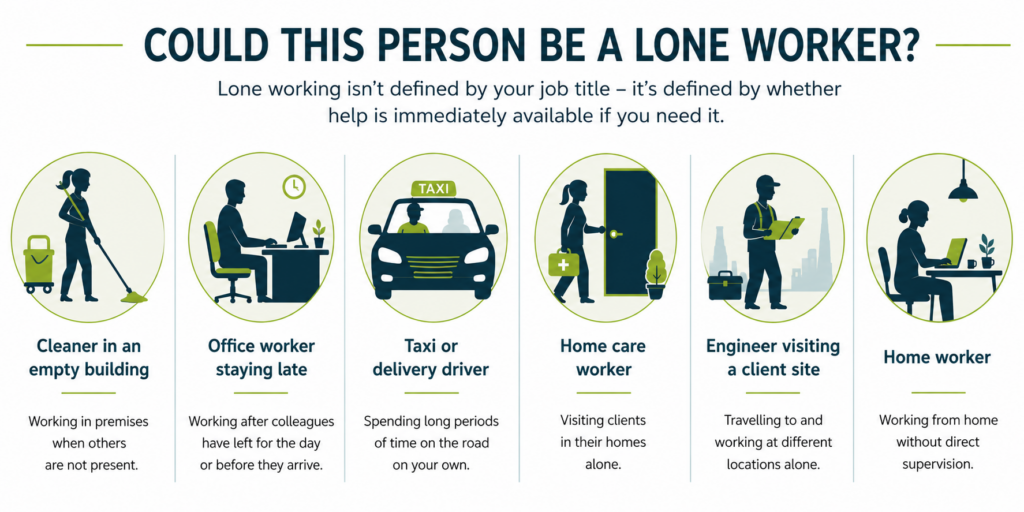
Whatever the industry, if an employee is working without direct supervision, the risks should be considered.
What are the risks?
The risks associated with lone working will vary depending on the work being carried out.
Examples include:
- Slips, trips and falls with nobody nearby to provide assistance
- Medical emergencies
- Violence or aggression from members of the public
- Vehicle breakdowns while travelling
- Fire or other emergencies
- Equipment failures
- Fatigue or stress, particularly during long periods of isolated working
Working alone doesn’t automatically make a task unsafe, but it can increase the consequences if an incident occurs.
Managing lone working safely
The first step is to carry out a suitable risk assessment.
Consider questions such as:
- Can the work be carried out safely by one person?
- What would happen if something went wrong?
- How would help be summoned?
- Is regular communication required?
- Does the employee have the necessary training and experience?
- Are there any medical conditions or personal circumstances that should be considered?
The answers will help determine the appropriate control measures.
Practical ways to reduce risk
Depending on the work, suitable controls may include:
- Regular check-in procedures
- Mobile phones or lone worker devices
- Emergency contact arrangements
- GPS tracking where appropriate
- Training in conflict management
- Avoiding high-risk tasks being carried out alone
- Clear emergency procedures
- Adequate lighting and security measures
The controls should always be proportionate to the level of risk.
What does the law say?
There is no specific law that prohibits employees from working alone.
However, employers have duties under the Health and Safety at Work etc. Act 1974 and the Management of Health and Safety at Work Regulations 1999 to assess risks and put suitable arrangements in place to protect employees.
The Health and Safety Executive (HSE) recommends that employers identify who works alone, assess the risks involved and review those arrangements regularly.
Related resources
Documents
E-learning
Need more help?
Whether your employees work in an office, travel between sites or spend time working alone, understanding the risks is essential.
The Health & Safety Portal provides practical guidance, downloadable resources and e-learning to help organisations identify lone workers, assess the risks and put suitable controls in place.