











Published: January 2026
Reading time: 5 minutes
Suitable for: Employers, Managers, Supervisors and Team Leaders
Topics: Toolbox Talks | Safety Communication | Training | Employee Engagement
At a glance
Effective Toolbox Talks should be:
- Short.
- Relevant.
- Interactive.
- Practical.
- Regular.
- Focused on one topic.
Remember:
The goal isn’t to deliver a perfect presentation—it’s to start a conversation that helps everyone work more safely.
Why this matters
Health and safety doesn’t stop once an employee completes their induction or annual training.
People forget information over time, workplaces change and new risks emerge.
Toolbox Talks provide an opportunity to keep safety at the forefront of everyone’s mind through short, focused discussions on specific health and safety topics.
When delivered well, they help reinforce safe behaviours, encourage employee involvement and create opportunities for valuable conversations.
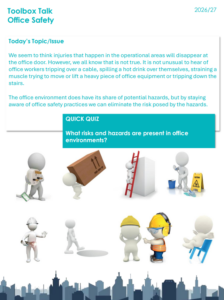 What is a Toolbox Talk?
A Toolbox Talk is a short health and safety briefing, usually lasting between five and fifteen minutes.
Each talk focuses on a single topic, such as:
- Manual handling
- Fire safety
- Slips, trips and falls
- Personal protective equipment (PPE)
- Working at height
- Driving for work
- Mental wellbeing
Unlike formal classroom training, Toolbox Talks are designed to be informal, practical and relevant to the work employees carry out every day.
Why are Toolbox Talks important?
People rarely change their behaviour because they’ve read a policy.
They change because someone starts a conversation.
Toolbox Talks give teams the opportunity to:
- Refresh important safety knowledge
- Discuss recent incidents or near misses
- Raise concerns
- Share practical experiences
- Learn from one another
- Reinforce safe working practices
Over time, these regular conversations help build a stronger safety culture.
A good Toolbox Talk isn’t a lecture
One of the biggest mistakes organisations make is treating Toolbox Talks as a presentation.
The best discussions involve everyone.
Instead of simply reading from a sheet of paper, encourage employees to:
- Ask questions
- Share experiences
- Discuss challenges
- Suggest improvements
- Explain how the topic applies to their work
When people participate, they’re much more likely to remember what they’ve learned.
Keep it relevant
Choose topics that reflect the work your team carries out.
For example:
- Discuss safe driving before employees begin winter journeys
- Review manual handling before a large delivery arrives
- Refresh fire safety before seasonal events
- Talk about heat stress during hot weather
- Cover slips and trips during icy conditions
Relevant discussions have a far greater impact than following the same schedule every year.
Making Toolbox Talks successful
A successful Toolbox Talk doesn’t require complicated presentations.
Instead:
- Keep it short and focused
- Choose one topic at a time
- Encourage discussion
- Use real workplace examples
- Ask open questions
- Give everyone an opportunity to contribute
- Finish with a clear safety message
Sometimes the most valuable part of a Toolbox Talk is hearing the experiences of the people doing the work every day.
What does the law say?
The Health and Safety at Work etc. Act 1974 requires employers to provide appropriate information, instruction, training and supervision to protect the health, safety and welfare of their employees.
The Management of Health and Safety at Work Regulations 1999 also require employers to provide employees with relevant health and safety information and training.
While Toolbox Talks are not specifically required by law, they are widely recognised as an effective way of reinforcing training, communicating safety information and engaging employees in health and safety.
Introducing our Toolbox Talk Library
To help businesses deliver engaging safety briefings, the Health & Safety Portal now includes a growing library of downloadable Toolbox Talks.
Each Toolbox Talk has been designed to be:
- Easy to deliver.
- Suitable for a wide range of workplaces.
- Based on current health and safety guidance.
- Ready to use with minimal preparation.
Whether you need a quick refresher or want to support a wider safety campaign, you’ll find practical resources to help you engage your workforce.
Need more help?
Good health and safety communication doesn’t happen by accident.
Regular, engaging Toolbox Talks help keep safety fresh in people’s minds, encourage discussion and give employees the confidence to raise concerns before incidents occur.
Visit the Toolbox Talk section of the Health & Safety Portal to explore our growing library of ready-to-use resources.