












Published: November 2024
Reading time: 6 minutes
Suitable for: Business Owners, Directors, Managers and Supervisors
Topics: Occupational Health | Employee Wellbeing | Eye Care | Display Screen Equipment (DSE)
At a glance
Main goal: Protect employees from work-related ill health.
Who should be involved? Employers, managers, supervisors and employees.
Key action: Identify health risks early and implement appropriate control measures.
Benefits: Improved employee wellbeing, reduced sickness absence and better long-term business performance.
Why this matters
A safe workplace is about more than preventing accidents. It also means protecting employees from work-related ill health, whether that’s caused by hazardous substances, repetitive tasks, excessive noise or prolonged use of display screen equipment.
Occupational health focuses on helping employees stay healthy while at work. By identifying health risks early and putting appropriate control measures in place, businesses can reduce sickness absence, improve employee wellbeing and create a healthier, more productive workplace.
What is occupational health?
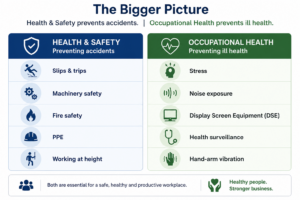
Occupational health is the process of identifying, managing and reducing the health risks associated with work.
Unlike safety measures, which often focus on preventing immediate injuries, occupational health considers the longer-term effects that work can have on a person’s physical and mental wellbeing.
Examples include:
- Display screen equipment (DSE)
- Noise exposure
- Hand-arm vibration
- Hazardous substances
- Manual handling
- Work-related stress
- Respiratory health
- Skin conditions
Managing these risks helps employees remain healthy throughout their working lives.
Eye care: More than just safety glasses
Eye care is a good example of how occupational health goes beyond personal protective equipment (PPE).
While safety glasses are essential where there is a risk of flying particles, chemicals or other eye hazards, many employees also spend long periods using computers, tablets or other display screen equipment.
Without suitable controls, prolonged screen use can contribute to:
- Eye strain
- Dry or tired eyes
- Headaches
- Blurred vision
- Neck and shoulder discomfort caused by poor workstation setup
Although these symptoms are usually temporary, they can affect comfort, concentration and productivity if left unaddressed.
What should employers consider?
Employers should assess workplace activities to identify any health risks that could affect employees over time.
Depending on the nature of the work, this may include:
Display Screen Equipment (DSE)
- Completing DSE assessments
- Providing adjustable workstations
- Positioning screens correctly
- Encouraging regular screen breaks
- Offering eyesight tests where required
Hazardous Work Activities
Where employees are exposed to physical hazards, employers should ensure:
- Suitable eye protection is provided
- PPE is maintained and replaced when necessary
- Employees are trained in the correct use of protective equipment
- Work areas are adequately lit
General Workplace Wellbeing
Occupational health may also include:
- Health surveillance where appropriate
- Ergonomic assessments
- Stress management
- Welfare facilities
- Workplace adjustments for individual needs
Every workplace is different, so occupational health arrangements should reflect the specific risks faced by your employees.
What should employees do?
Employees also play an important role in protecting their own health.
They should:
- Follow safe working procedures
- Use PPE correctly when required
- Report damaged or unsuitable equipment
- Complete DSE assessments honestly
- Take regular screen breaks
- Report any symptoms that may be work-related
Reporting concerns early allows employers to investigate and implement appropriate controls before problems become more serious.
What does the law say?
Under the Health and Safety at Work etc. Act 1974, employers have a duty to protect the health, safety and welfare of their employees.
The Management of Health and Safety at Work Regulations 1999 require employers to assess workplace risks and implement suitable control measures.
Where employees regularly use display screen equipment as part of their work, the Health and Safety (Display Screen Equipment) Regulations 1992 require employers to assess workstations, reduce identified risks and provide eyesight tests on request for eligible DSE users.
Where eye protection is required because of workplace hazards, employers must provide suitable personal protective equipment in accordance with the Personal Protective Equipment at Work Regulations 1992.
Related resources
Documents
E-learning
Need more help?
Looking after employee health is an important part of effective health and safety management. The Health & Safety Portal provides practical resources to help businesses identify and manage occupational health risks, including DSE assessments, policy templates, risk assessments, e-learning courses and toolbox talks.
By taking a proactive approach to occupational health, you can help prevent work-related ill health, support employee wellbeing and create a workplace where people can perform at their best.