










Published: November 2025
Reading time: 6 minutes
Suitable for: Employers, Managers, Supervisors and Employees
Topics: Permit to Work | High-Risk Activities | Risk Assessment | Safe Systems of Work
At a glance
A Permit to Work:
- Controls higher-risk work
- Does not replace a risk assessment
- Confirms safety controls are in place
- Improves communication
- Requires competent authorisation
- Helps prevent serious incidents
Remember:
A permit is not permission to take a risk. It is confirmation that the risks have been understood and controlled.
Why this matters
Some workplace activities are inherently more dangerous than others.
Tasks involving hot work, confined spaces, electrical systems or lone working can expose employees to significant risks if they aren’t properly planned and controlled.
A Permit to Work (PTW) is one of the ways organisations manage these higher-risk activities.
Despite the name, a permit isn’t simply permission to carry out a task. It’s a formal process that helps ensure the work can be completed safely.
What is a Permit to Work?
A Permit to Work is a documented system used to control work that presents a higher level of risk.
It confirms that:
- The work has been properly assessed
- Hazards have been identified
- Appropriate control measures are in place
- Everyone involved understands their responsibilities
- The work has been authorised by a competent person
Think of it as the final safety check before work begins.
A permit doesn’t replace a risk assessment
One of the biggest misunderstandings is believing that a permit replaces a risk assessment.
This is not true.
The risk assessment identifies the hazards and determines the control measures.
The Permit to Work confirms that those controls have actually been implemented before work starts.
The two documents work together. A Permit to Work must never be issued without a corresponding risk assessment.
When might a Permit to Work be needed?
Permit systems are commonly used for activities such as:
- Hot work
- Confined space entry
- Electrical isolation and maintenance
- Excavation work
- Roof work
- Work on pressurised systems
- Certain lone working activities
Every organisation should decide which activities require permits based on the level of risk.
What does a Permit to Work include?
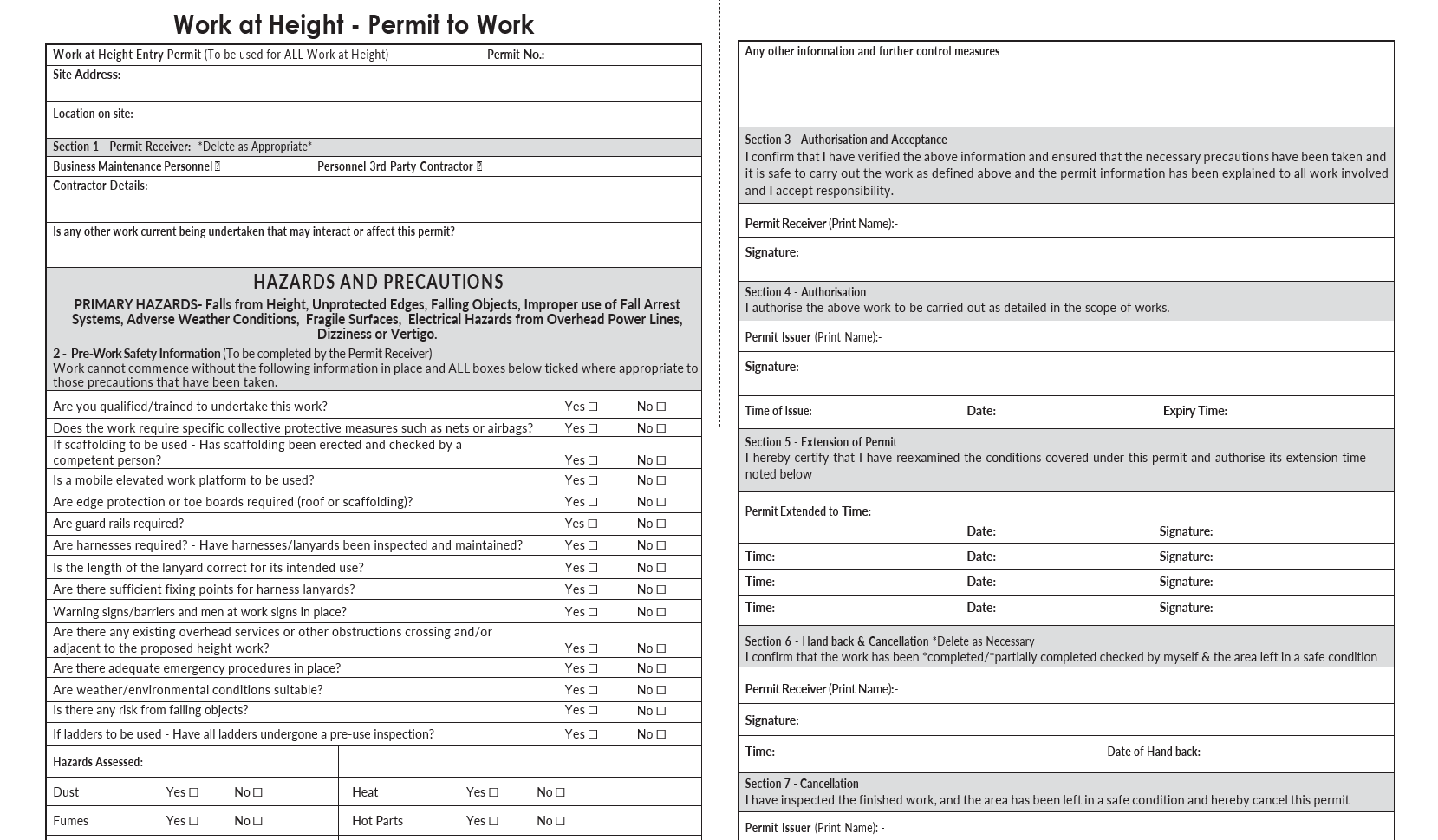
Although formats vary, most permits include:
- The location of the work
- A description of the task
- The hazards involved
- Required control measures
- PPE requirements
- Isolation arrangements
- Emergency procedures
- Names of authorised persons
- Start and finish times
- Sign-off when work is complete
This creates a clear record of how the work will be carried out safely.
Why are permits important?
High-risk work often involves multiple people, contractors or departments.
A Permit to Work helps ensure everyone understands:
- What work is taking place
- Where it is happening
- What hazards exist
- What precautions must remain in place
- When the work is complete
Without this communication, important safety controls can easily be missed.
Common mistakes
A Permit to Work system is only effective if it’s used correctly.
Common mistakes include:
- Treating permits as paperwork rather than a safety process
- Signing permits without checking the workplace
- Failing to brief those carrying out the work
- Allowing permits to continue after conditions have changed
- Forgetting to formally close the permit once work has finished
The permit should reflect what is actually happening on site—not what was planned several hours earlier.
What does the law say?
There is no single piece of legislation requiring every workplace to operate a Permit to Work system.
However, employers have duties under the Health and Safety at Work etc. Act 1974 and the Management of Health and Safety at Work Regulations 1999 to assess risks and implement suitable control measures.
For many high-risk activities, a Permit to Work is recognised by the HSE as an effective method of controlling those risks as part of a safe system of work.
Related resources
Documents
- Confined Space Permit to Work
- Working at Height Permit to Work
- Hot Works Permit to Work
- Lone Working Permit to Work
E-learning
Need more help?
A well-managed Permit to Work system helps ensure that higher-risk activities are properly planned, communicated and controlled before work begins.
The Health & Safety Portal provides practical templates, guidance and e-learning to help organisations develop effective permit systems and manage high-risk work safely.