










Published: July 2025
Reading time: 6 minutes
Suitable for: Employers, Managers and Employees
Topics: Manual Handling | Musculoskeletal Disorders | Risk Assessment | Workplace Safety
At a glance
Avoid unnecessary manual handling wherever possible.
Assess every unavoidable task using TILE.
Reduce the weight, distance and frequency of lifts.
Use mechanical aids or team lifting where appropriate.
Remember: The safest lift is often the one you never need to make.
Why this matters
Manual handling injuries are one of the most common causes of lost working days in the UK.
While many people associate manual handling with warehouses or construction sites, almost every workplace involves some form of lifting, carrying, pushing, pulling or moving objects.
The effects aren’t always immediate. Poor manual handling techniques and repetitive movements can contribute to long-term musculoskeletal disorders (MSDs), affecting the back, shoulders, neck, arms and joints.
The good news is that many of these injuries are preventable.
Manual handling isn’t just lifting
Manual handling is any activity that involves:
- Lifting
- Lowering
- Carrying
- Pushing
- Pulling
- Holding
- Moving a load by hand or bodily force
A “load” doesn’t have to be a heavy box. It could be:
- Office equipment
- Boxes of paper
- Deliveries
- Furniture
- Laptops
- Catering supplies
- Waste bags
Think before you lift
Many people jump straight to thinking about lifting technique.
A better question is:
“Do I actually need to lift this at all?”
The best way to prevent a manual handling injury is to eliminate the need for manual handling wherever possible.
For example:
- Use a trolley instead of carrying boxes
- Split large deliveries into smaller loads
- Store heavy items between knee and shoulder height
- Use lifting equipment where available
- Ask for assistance with awkward or bulky items
Reducing manual handling is always better than relying on good lifting technique alone.
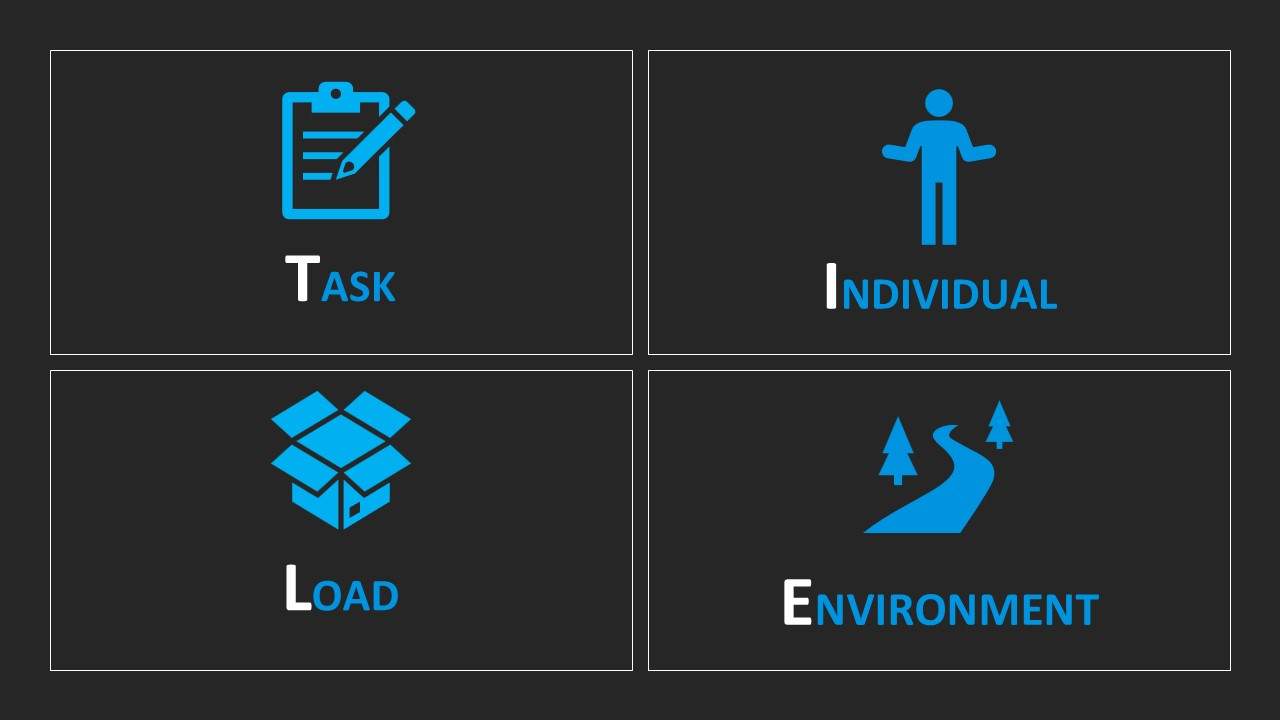
Remember TILE
If manual handling can’t be avoided, think about TILE before you begin.
Task
Consider:
- How far will the load be moved?
- Will you need to twist, reach or bend?
- Is there enough space?
- Can the task be redesigned?
Individual
Think about the person carrying out the task.
Do they:
- Have the necessary training?
- Have any health conditions or injuries?
- Have the strength and capability for the task?
- Need assistance?
Load
Consider whether the load is:
- Heavy
- Large
- Difficult to grip
- Unstable
- Sharp
- Likely to move unexpectedly
Environment
Check the area for hazards such as:
- Uneven flooring
- Poor lighting
- Wet or slippery surfaces
- Obstacles
- Limited space
- Stairs
Manual handling in the office
Office workers often assume manual handling doesn’t apply to them—but that’s rarely true.
Examples include:
- Carrying archive boxes
- Moving desks or filing cabinets
- Handling deliveries
- Transporting laptops and equipment
- Repeatedly lifting paper or supplies
These tasks may seem low risk, but repeated awkward movements over months or years can contribute to back, neck and shoulder problems.
Good planning is just as important in an office as it is on a construction site.
Small strains can become long-term injuries
Many manual handling injuries don’t happen because of one dramatic accident.
Instead, they develop gradually through:
- Repetitive lifting
- Poor posture
- Awkward reaching
- Twisting while carrying
- Lifting loads that are heavier than necessary
By the time discomfort appears, damage may already have begun.
That’s why preventing poor manual handling is far better than treating an injury later.
What does the law say?
The Manual Handling Operations Regulations 1992 (as amended) require employers to:
- Avoid hazardous manual handling activities where reasonably practicable
- Assess manual handling tasks that cannot be avoided
- Reduce the risk of injury as far as reasonably practicable
- Provide employees with appropriate information and training
Related resources
Documents
E-learning
Need more help?
Whether your employees work in an office, warehouse, workshop or out on site, good manual handling practices help prevent injuries before they happen.
The Health & Safety Portal provides practical guidance, document templates, toolbox talks and e-learning to help your organisation assess manual handling risks and reduce the likelihood of injury.