











Published: October 2026
Reading Time: 5–7 minutes
Suitable for: Employers, Managers and Employees
Topics: Workplace Safety, Housekeeping, Slips and Trips, Workplace Maintenance
At a glance
Why this matters
Good housekeeping is one of the simplest ways to make a workplace safer — but it is also one of the easiest things to overlook.
A box left in a walkway, a trailing cable, a leaking container or a bin that has been allowed to overflow might not seem like a serious health and safety issue. However, small problems can quickly become hazards for employees, visitors and anyone else who enters your workplace.
The Health and Safety Executive (HSE) identifies good housekeeping as an important part of preventing slips and trips, with many workplace incidents being preventable through straightforward measures such as keeping walkways clear, dealing with spillages promptly and maintaining the workplace.
So, what does good housekeeping actually look like?
The Do’s
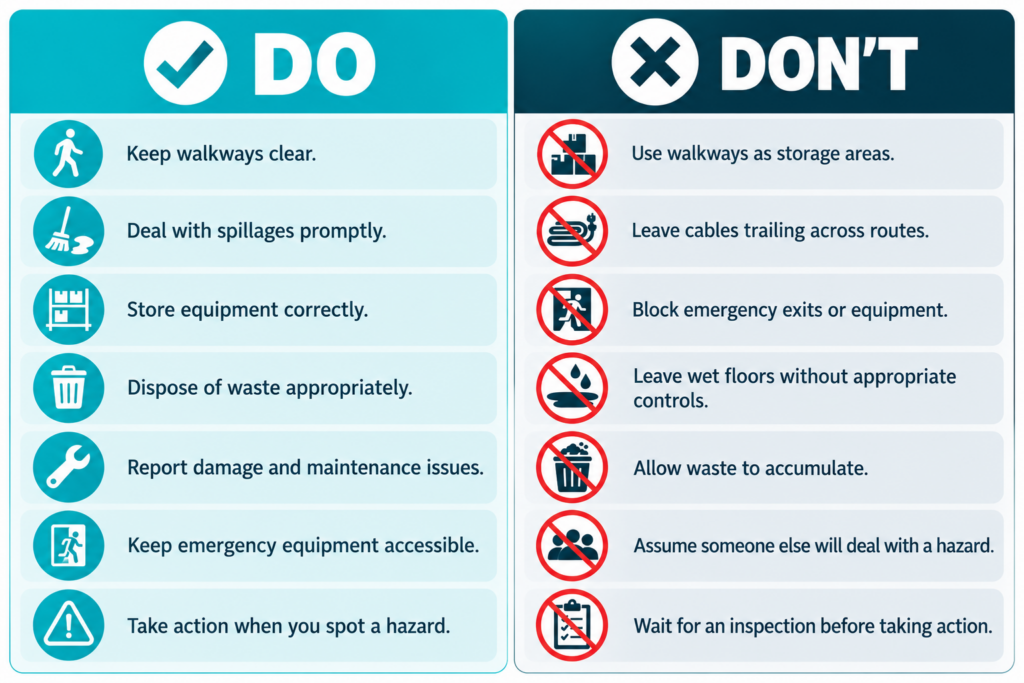
Do – keep walkways and access routes clear
Employees should be able to move around the workplace without having to step over, walk around or squeeze past obstacles.
Keep:
- Walkways clear
- Emergency exits accessible
- Stairways free from storage
- Access to equipment unobstructed
- Pedestrian routes clearly defined
Don’t assume that something is safe simply because people have become used to walking around it.
Do – deal with spillages quickly
Water, oil, cleaning products, food and other substances can create serious slip hazards.
HSE guidance recommends having effective arrangements for dealing with spillages and making sure that cleaning itself doesn’t introduce an additional slip or trip hazard.
Do – put waste in the correct place
Waste should be disposed of promptly and in suitable containers.
Think about:
- General waste
- Recycling
- Food waste
- Sharps or hazardous waste
- Chemical containers
- Contaminated materials
Waste should not be allowed to accumulate around the workplace. The Workplace (Health, Safety and Welfare) Regulations 1992 require workplaces to be kept sufficiently clean and, so far as reasonably practicable, prevent waste materials from accumulating except in suitable receptacles.
Do – put equipment away after use
Tools, equipment and materials should have a designated storage location. This makes equipment easier to find, reduces trip hazards and helps identify missing or damaged equipment.
Do – report damaged areas
Good housekeeping isn’t just about cleaning.
Report things such as:
- Damaged flooring
- Loose mats
- Broken shelving
- Damaged storage areas
- Leaking equipment
- Poor lighting
- Damaged walkways
A housekeeping problem can sometimes be an indication of a maintenance problem that needs to be addressed.
The Don’ts
Don’t – use walkways as storage
A walkway isn’t a temporary storage area.
That delivery might only be there for ten minutes, but if someone trips over it during those ten minutes, the responsibility is on your business.
If something needs to be stored, put it somewhere appropriate.
Don’t – leave cables and leads trailing
Trailing cables can create trip hazards and may also become damaged if they are walked over or caught by equipment.
Where possible:
- Route cables away from walkways
- Use suitable cable management
- Keep electrical equipment positioned appropriatel
- Don’t create makeshift solutions that introduce additional hazards
Don’t – block emergency equipment
Fire extinguishers, fire alarm points, emergency exits, first aid equipment and other safety equipment must remain accessible. If someone uses a fire extinguisher to prop open a door, make sure it is returned to where it needs to be, and address the behaviour.
Don’t – assume cleaning means the area is safe
Cleaning can actually introduce new hazards.
Wet floors, cleaning equipment, hoses and electrical cables can all create additional risks if they aren’t properly managed. Where floors are wet, appropriate measures should be taken to prevent people entering the area until it is safe.
Don’t – leave it for somebody else
One of the biggest problems with housekeeping is the phrase:
“That’s not my job.”
You might not be responsible for cleaning the workplace, but everyone has a role to play in keeping it safe.
If you see something that could cause harm, don’t simply walk past it.
Where you can safely resolve the problem, do so. If it requires someone else to deal with it, report it.
Make housekeeping everyone’s responsibility
Good housekeeping works best when it becomes part of the normal working day rather than something that happens only when an inspection is approaching.
Managers can help by:
- Providing suitable storage
- Setting clear expectations
- Making cleaning arrangements clear
- Providing suitable waste facilities
- Acting on reported problems
- Checking that standards are maintained
Employees can help by:
- Keeping their own work areas tidy
- Storing equipment correctly
- Dealing with spillages appropriately
- Reporting hazards
- Keeping access routes clear
- Speaking up when something isn’t right.
Related resources
E-learning
Toolbox Talks
Need more help?
Your Harwood Health & Safety Portal contains practical resources to help you manage housekeeping and the hazards associated with poor workplace standards.
Explore the related risk assessments, e-learning courses, toolbox talks and H&S documents available on your Portal and use them to help turn good housekeeping into part of your everyday safety culture.
Remember:
A safer workplace often starts with the things we walk past every day.